




Understanding Modern GCC Growth in India
A Global Capability Centre (GCC) is a dedicated offshore unit set up by multinational companies to manage critical business functions such as technology, operations, finance, analytics, and product development. These centres act as strategic extensions of global headquarters rather than just cost-saving back offices.
India as a GCC Hub
India's GCC ecosystem has expanded rapidly over the last decade, supported by a technology talent pool, strong digital infrastructure, and government policies that encourage foreign investment. Global companies now operate hundreds of capability centres across major hubs such as Bengaluru , Hyderabad , Pune , and Gurgaon .
The Evolution of GCC Function
These centres no longer function only as cost-saving back offices. Many GCCs now manage engineering, R&D, analytics, and product development for global organisations. As their responsibilities grow, so does the need for office environments that can support rapid scaling without long setup delays.
Why GCCs Choose Managed Office Spaces
Several operational and strategic factors are driving global companies to adopt managed office spaces instead of conventional long-term office leases.
Faster Setup for Quick Market Entry
Speed matters when companies launch a GCC. Traditional offices often take months to design, secure approvals, and set up infrastructure. Managed offices shorten this timeline significantly. Organisations can move into fully functional workspaces within weeks and begin hiring or operating immediately.
Zero CapEx with an OPEX-Driven Model
Setting up an independent office requires major upfront capital for interiors, IT infrastructure, and facility setup. Managed offices shift this model to operational expenditure instead. GCCs can avoid heavy capital commitments while maintaining predictable monthly costs.
Custom-Built Workspaces for GCC Teams
Unlike generic coworking setups , managed office spaces can be designed specifically for an organisation. Floor plans, meeting rooms, collaboration areas, and security zones can be configured according to the GCC's operational structure and workflow.
Enterprise-Grade IT and Security Infrastructure
Global organisations operate under strict security and compliance requirements. Incuspaze workspaces are designed to meet global security compliance requirements, including ISO 27001-aligned network infrastructure, access-controlled server rooms, and CCTV-monitored common areas. These are the standards that GCCs in BFSI, healthcare, and technology sectors require.
Scalability and Multi-City Expansion Options
As GCC teams grow, workspace requirements change quickly and they rarely follow a predictable timeline. A team of 50 may need to scale to 200 within a year, or a new project mandate may require a presence in a second Indian city within weeks.
Managed offices are built for exactly this kind of growth. Companies can expand seating capacity, reconfigure floor layouts, or add entirely new locations without the delays and capital commitments that come with renegotiating a traditional lease or sourcing a new office from scratch.
Providers like Incuspaze, with 80+ locations across 18+ Indian cities, make it possible to add a new city presence without sourcing a separate vendor or renegotiating a lease.
End-to-End Facilities and Space Management
Running a large office involves multiple operational tasks such as maintenance, vendor coordination, utilities management, and workplace services. Managed office providers handle these responsibilities centrally, allowing GCC leadership teams to focus on business operations rather than facility administration.
Better Employee Experience and Wellness Features
Modern GCCs compete globally for talent. Workplace quality influences employee satisfaction and productivity. Managed offices often include collaborative spaces, wellness zones, cafeterias, and modern meeting infrastructure that support a healthier work environment.
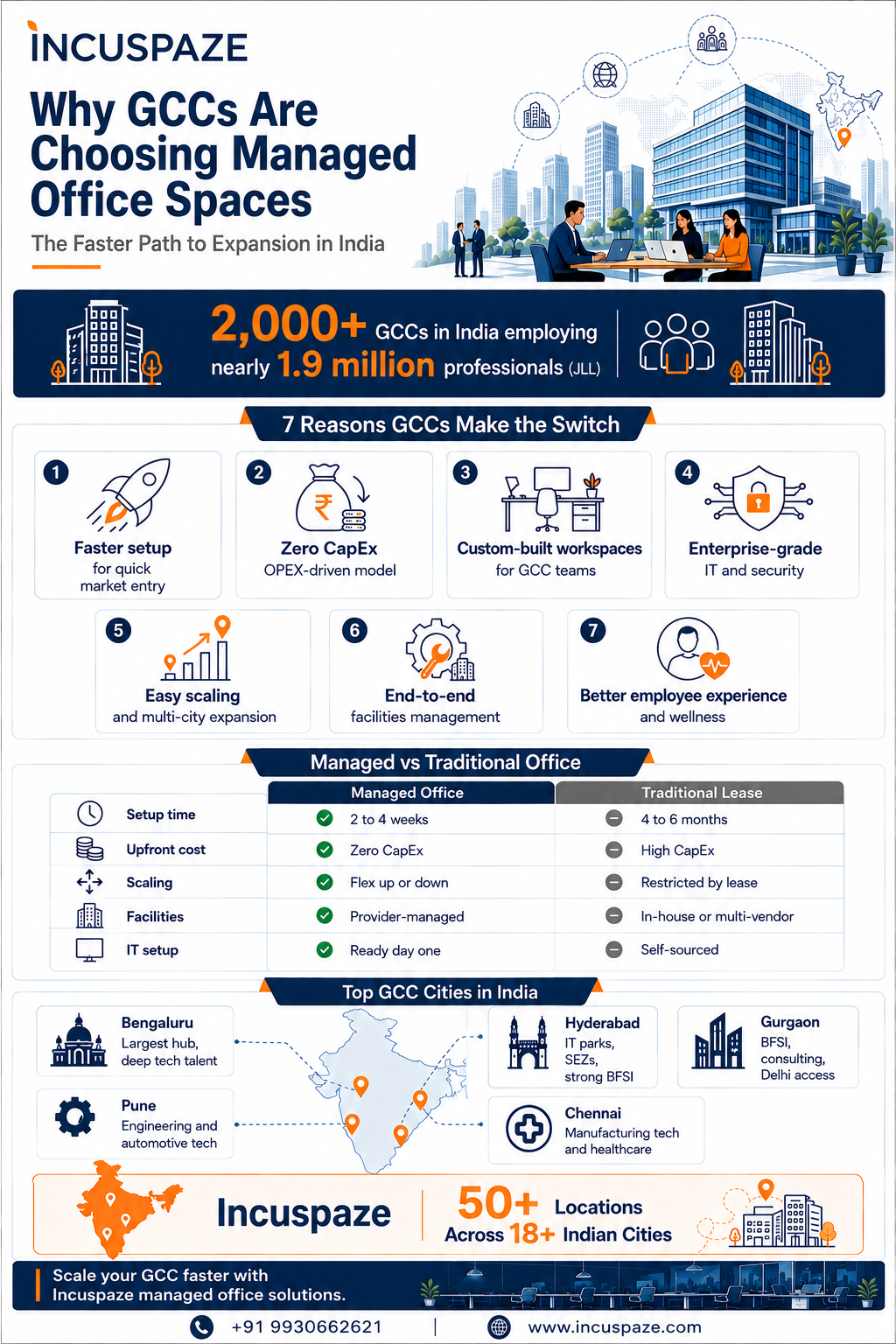
Here's a quick comparison of how managed offices stack up against traditional leased offices across the dimensions that matter most to GCC teams:
| Dimension | Managed Office | Traditional Leased Office |
|---|---|---|
| Setup Time | 2–4 weeks | 4–6 months |
| Upfront Investment | Zero CapEx | High CapEx (fit-out, IT, furniture) |
| Scaling | Flex up/down as needed | Restricted by lease terms |
| Facility Management | Provider-managed | In-house / multi-vendor |
| IT Infrastructure | Enterprise-grade, ready day one | Self-sourced and deployed |
Impact of Managed Offices on GCC Expansion in India
Managed office spaces are increasingly reshaping how global companies establish and scale their GCC operations. Instead of investing heavily in real estate infrastructure, organisations can focus on talent acquisition and operational growth, with workspace management handled externally.
India's Top GCC Cities and Why Location Matters
Location is a strategic decision for any GCC. The right city determines access to talent, proximity to clients, and the speed at which operations can scale. Here is where GCC activity is concentrated in India and why:
- Bengaluru remains India's largest GCC hub, home to technology, engineering, and product development centres for some of the world's biggest companies. Incuspaze operates across multiple locations in the city, giving GCC teams access to Bengaluru's deep tech talent pool.
- Hyderabad has emerged as the second-largest GCC destination, driven by its IT parks, SEZs, and strong BFSI and analytics sector presence. The city offers competitive real estate costs alongside enterprise-grade infrastructure.
- Pune is a growing choice for GCCs in engineering, automotive technology, and financial services, supported by a large graduate talent base and well-developed IT corridors.
- Gurgaon serves GCCs that require proximity to Delhi for government relations, international airport access, and a concentration of BFSI and consulting sector clients.
- Chennai is gaining traction for GCCs in manufacturing technology, healthcare, and shared services, with a strong supply of engineering and operations talent.
For GCC leaders evaluating where to establish or expand operations, Incuspaze's presence across all five cities and 13+ others means workspace decisions do not slow down expansion timelines.
Scale Your GCC Faster with Incuspaze Managed Office Solutions
Managed office spaces have emerged as a preferred workspace model for companies establishing or expanding Global Capability Centres in India. They provide faster setup, eliminate large upfront investments, and allow organisations to scale operations without being tied to long-term infrastructure commitments.
For companies seeking flexibility and operational efficiency, Incuspaze's managed office spaces offer a practical solution. Incuspaze provides premium, fully serviced workspaces across 80+ locations in 18+ Indian cities, including Bengaluru, Hyderabad, Pune, and Gurgaon, with enterprise infrastructure, scalable layouts, and end-to-end facility management.
For GCC leaders focused on speed, flexibility, and long-term scalability, Incuspaze enables a workspace strategy that keeps their expansion plans on track.

FAQs on Managed Office Spaces for GCCs
Organisations evaluating workspace options often have several questions before choosing a managed office model.
Are managed offices cost-effective for large teams?
Yes. Managed offices can be cost-effective for large teams because they eliminate major upfront capital investments in infrastructure and interiors. Instead of funding large fit-out projects, companies pay predictable operational costs while still accessing enterprise-grade workspace infrastructure.
What are the benefits of managed office spaces for GCCs in India?
Managed offices offer faster setup, flexible scaling, enterprise IT infrastructure, and full facility management support. These benefits allow GCCs to focus on business operations while the workspace provider handles infrastructure and daily administrative responsibilities.
Can managed offices be customised for GCC needs?
Yes. Managed office spaces can be designed according to the operational structure of a GCC. Companies can customise seating layouts, meeting areas, collaboration zones, security controls, and branding elements to match their specific business requirements.
How do managed offices help reduce costs for GCCs?
Managed offices reduce costs by removing the need for large capital investments in office construction and infrastructure. They also simplify vendor management because utilities, maintenance, and facility services are handled by the workspace provider under a single operational model.