



Introduction
Founders, operations leaders, and business heads in India face confusion with flexible workspaces. Should you choose a serviced office or a coworking space for your headcount, capital plans, and growth trajectory?
According to CBRE India Research's Flex-plosion: India's Flexible Workspaces Era report, published in collaboration with FICCI, nearly 65% of office occupiers in India expect to integrate flexible workspaces into their portfolios by 2027, while 55% already have them.
Flex space covers two distinct models, serviced offices and coworking spaces, and choosing the wrong one costs an organisation money and morale. The short answer: coworking suits teams of one to eight that value cost flexibility over privacy, while a serviced office suits teams of eight or more that need a private, lockable space and predictable all-inclusive billing. This article defines each model, sets out the key differences, weighs the pros and cons, and offers a decision framework to help you choose with confidence.
What is a Coworking Space?
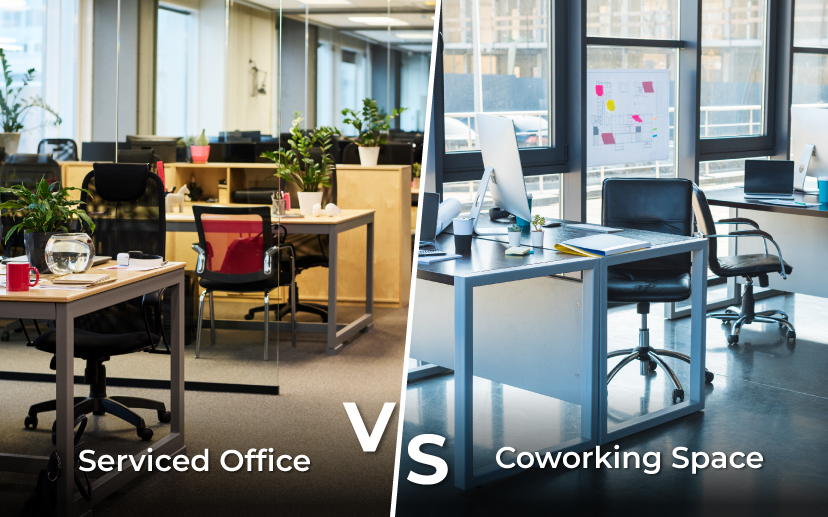
A coworking space is a shared, open workspace where individuals and small teams from different companies work side by side under a flexible membership. In India, the typical setup is an open floor plan combining hot desks, dedicated desks, and small private cabins for teams that need a degree of separation. It is one of the most common flex space formats for freelancers, remote workers, and startups.
Membership usually includes high-speed Wi-Fi, meeting rooms, a reception desk, a pantry or cafeteria, and community events built into the calendar. The typical user is a freelancer, remote worker, early-stage startup, or a small team of 1 to 8 people, for whom collaboration and exposure to a wider network add to the appeal. Incuspaze's coworking spaces offer this setup across major Indian cities, with plans that scale as a team grows.
What is a Serviced Office?
A serviced office is a fully furnished, fully equipped, private office space leased and managed by a provider, giving one organisation exclusive, lockable occupancy along with built-in amenities and services. The typical setup in India is a private suite or a full floor within a managed building in a prime business district. It is fitted out with ergonomic furniture, breakout zones, phone booths, and a wellness room, and scaled to the size of the team occupying it. In India, this model is more commonly marketed as a managed office, so the two terms usually refer to the same thing.
Included services typically span high-speed Wi-Fi, meeting rooms, utilities, housekeeping, maintenance, concierge and front desk support, and IT assistance. The standard user is an established SME, an enterprise, an MNC, or a GCC setting up or scaling its India footprint. Flex has become an enterprise-scale segment rather than a startup one: it accounted for 25.9% of India's office demand in Q1 2026, second only to GCCs at 45.5%. Incuspaze's managed office spaces follow this model, offered on a zero capex basis across major Indian cities.
Serviced Office vs Coworking Space: A Quick Comparison
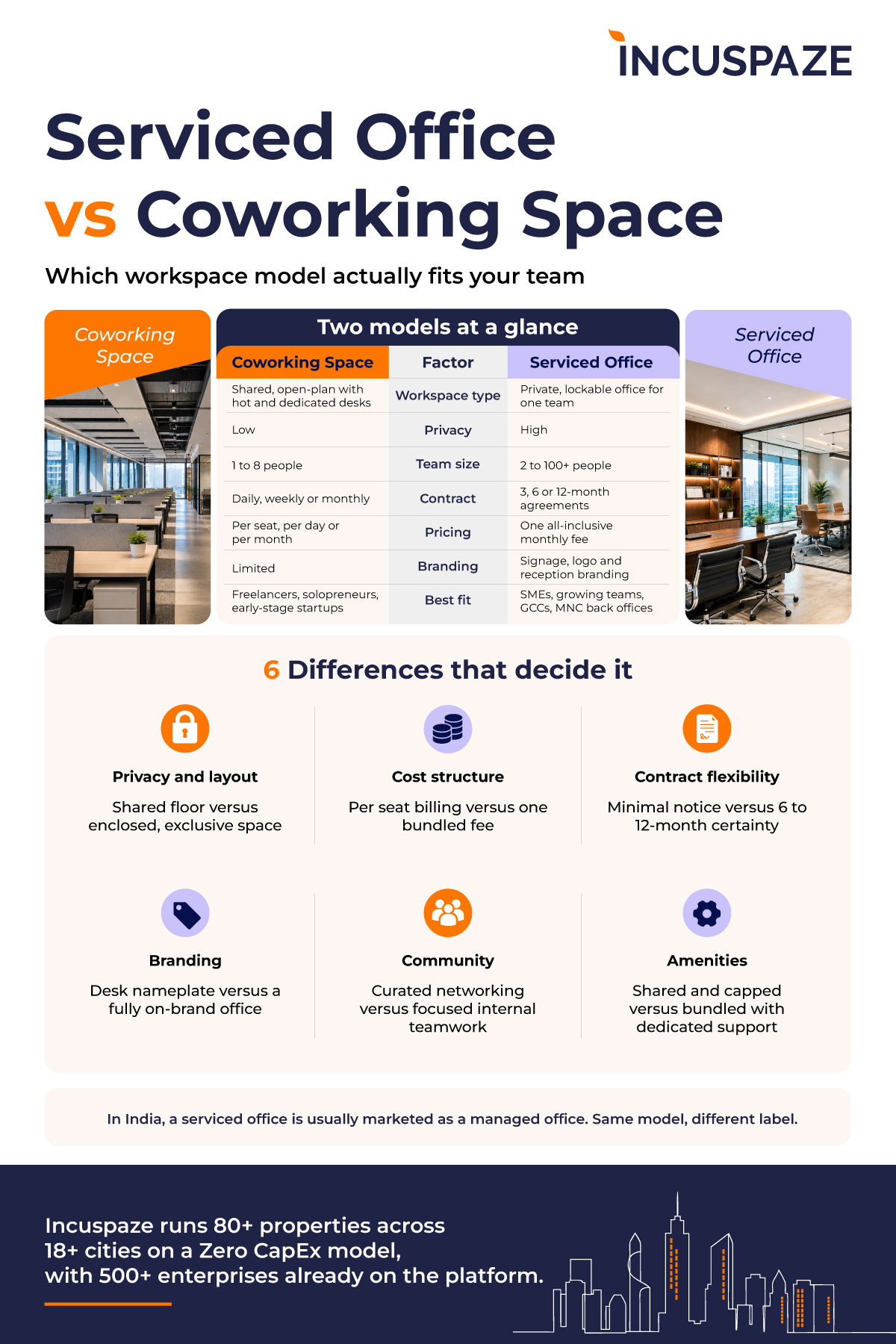
Before the detailed differences, here is a side-by-side snapshot of how the two models compare on the factors that matter most to a decision-maker: privacy, contract length, pricing structure, branding, and the team size each model is built for. Incuspaze offers both models under one roof, so the comparison below reflects the choice you would actually be making.
| Factor | Coworking Space | Serviced Office |
|---|---|---|
| Workspace Type | Shared, open-plan with hot desks and dedicated desks | Private, lockable office for one team |
| Privacy Level | Low (shared, open environment) | High (enclosed, exclusive space) |
| Typical Team Size | 1 to 8 people | 2 to 100+ people |
| Contract Length | Daily, weekly, or monthly memberships | 3, 6, or 12-month agreements |
| Pricing Model | Pay per seat, per day, or monthly membership | All-inclusive monthly fee for the whole office |
| Branding | Limited (shared environment) | Strong (your team's exclusive space) |
| Cost Indicator (per seat) | Lower upfront cost | Higher per-seat cost, all-inclusive |
| Best Fit For | Freelancers, solopreneurs, early-stage startups | Established SMEs, growing teams, GCCs, MNC back offices |
Key Differences Between Serviced Offices and Coworking Spaces
These differences directly affect day-to-day work, monthly spend, and how a team scales over time.
Privacy and Workspace Layout
Coworking spaces are open-plan and shared with individuals and teams from other companies, while a serviced office is enclosed for the exclusive use of one organisation. In practice, serviced offices provide private space for focused work and confidential conversations, making client meetings easier to manage in a controlled environment. Coworking suits work that does not depend on visual or acoustic privacy. Pick a serviced office when confidentiality or client-facing meetings are a regular part of the working week.
Cost Structure
Coworking is priced per seat, per day, or per month, while a serviced office is billed as one bundled, all-inclusive fee for the whole private office. Coworking tends to be affordable for teams of one to five people, but at eight to ten or more seats, a serviced office often matches or beats coworking on a per-seat basis once meeting room and add-on charges are counted. Coworking can also carry hidden costs such as meeting room credits, printing, and add-ons, whereas serviced offices offer more predictable billing because utilities, maintenance, and shared facilities are usually included.
Contract Flexibility
Coworking spaces offer daily, weekly, or monthly memberships with minimal notice, while serviced offices typically require 3, 6, or 12-month agreements. This makes coworking suited to unpredictable or fast-changing headcount. Serviced offices are the better fit for teams that do not want the commitment of a conventional lease but are confident about their footprint over the next 6 to 12 months. Choose contract length based on how certain your team size and city plans are over that horizon, not on price alone.
Branding and Customisation
Coworking limits branding to a desk, cabin door, or shared nameplate, while a serviced office allows logo placement, signage, and reception branding for a consistent, on-brand client experience. For organisations meeting investors, auditors, or enterprise clients on-site, this distinction shapes the first impression the space creates. When brand identity and a custom-built office environment are non-negotiable, a serviced office is the stronger choice.
Community and Networking
Coworking is built around community, with curated events, shared lounges, and informal interaction across member companies, while a serviced office is built for focused, internal teamwork with limited cross-company mixing. Networking is a genuine growth lever for freelancers and early-stage founders, but it matters less to delivery-focused enterprise or GCC teams executing a fixed mandate. Choose coworking when organic networking adds measurable value to the business.
Amenities, Meeting Rooms, and Services
Both models typically offer Wi-Fi, meeting rooms, reception, housekeeping, a pantry, mail handling, and 24/7 access across most India-based providers. Serviced offices generally add dedicated concierge and front desk support, prioritised IT assistance, more bundled meeting room hours, and greater infrastructure flexibility for fit-outs. In coworking, amenities are shared, so meeting rooms must be booked in advance and some add-ons carry usage caps.

Pros and Cons of a Serviced Office
- Full privacy and an exclusive, lockable space
- Predictable, all-inclusive pricing
- Strong brand presence and a custom-built environment
- Fully managed services, including housekeeping and IT support
- More meeting room bandwidth
- Easier headcount scaling within the same building
- A premium address without a long-term lease
Cons:
- Higher per-seat cost than coworking
- Longer commitment, typically 3 to 12 months
- Limited infrastructure customisation compared with a self-built office
- Fewer organic networking opportunities
- Less flexibility if team size drops month on month
Pros and Cons of a Coworking Space
- Low upfront cost
- Very short commitments
- Strong networking and community access
- Plug-and-play infrastructure from day one
- A professional business address
- Fast per-seat scaling as headcount grows
Cons:
- Low privacy in a shared, open environment
- Noise and distractions during peak hours
- Weak control over branding
- Hot desk availability can tighten at peak times
- Meeting rooms must be booked in advance
- Recurring add-on costs for extras
When to Choose a Serviced Office
A serviced office is the stronger fit when any of the following apply: the team has crossed 8 to 10 people and is actively hiring; the work involves sensitive or regulated data, as in BFSI, legal, healthcare, or R&D; client meetings or audits happen on-site; or the brand needs a consistent, on-brand environment. The team will stay in the city for at least 6 to 12 months, or IT and infrastructure requirements are specific to the business. If two or more of these apply, a serviced office is the better long-term call. Incuspaze's enterprise workspace solutions are built around exactly this scenario, covering multi-city expansion, workspace design, and fully managed operations.
When to Choose a Coworking Space
Coworking is the stronger fit for a solo founder, a freelancer, or a team of 1 to 5 people, and for remote-first businesses that need an occasional base rather than a permanent one. Testing a new city becomes simpler with coworking. It also supports work that grows through networking, such as consulting, sales, creative agencies, and early-stage startups. Privacy needs are minimal here, and budgets stay flexible with pay-per-seat scaling. For early-stage businesses, coworking is usually the smarter starting point, with a move into a serviced office once the team expands past eight to ten people.
How Incuspaze Helps You Find the Right Workspace
Incuspaze operates across the full spectrum of flex space, from coworking and dedicated desks to private cabins, managed offices, and custom-built enterprise spaces under one roof. This means an organisation can start with a handful of desks and scale into a fully managed office within the same partner, without switching providers as requirements change.
For enterprise, MNC, and GCC decision-makers, the practical advantages are a pan-India presence, all-inclusive and transparent pricing, plug-and-play infrastructure, scalability from a single seat to 200+ seat managed offices, and a dedicated community manager throughout the tenancy. Explore Incuspaze's managed office spaces if your team has crossed eight to ten people, or its coworking spaces if you are still testing the market.