





Introduction
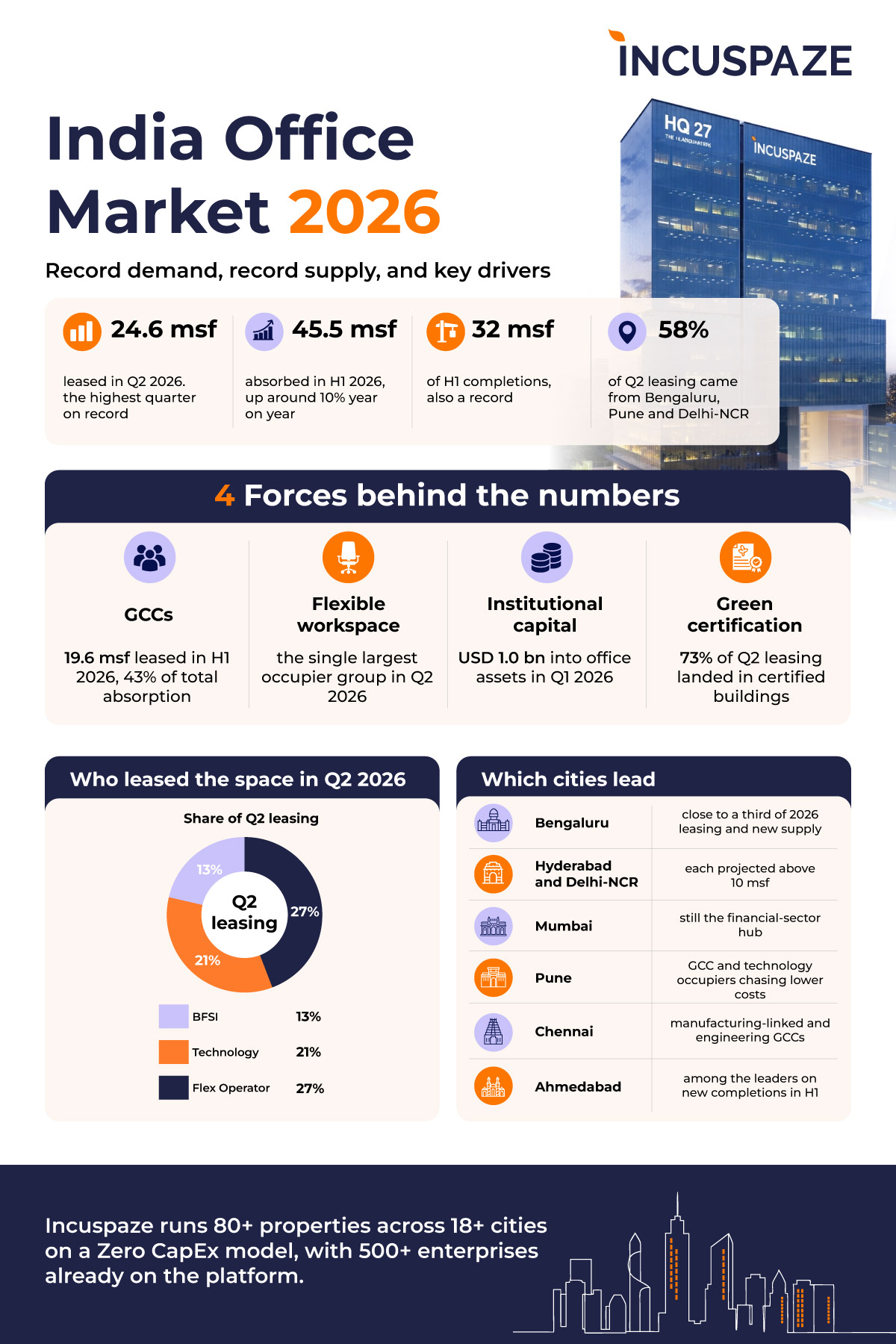
If you're scanning an India office market report this quarter, one number jumps out. Occupiers leased 24.6 million square feet in Q2 2026 alone, the highest quarterly figure on record, and H1 2026 closed at 45.5 million square feet, a record for any six-month stretch, up around 10% year on year on CBRE's numbers.
GCCs and flexible workspace operators are doing most of the heavy lifting. But ask CBRE and Colliers for the full picture, and you'll get numbers that don't quite line up. CBRE puts H1 2026 absorption at 45.5 million square feet. Colliers, which tracks only the top seven cities, reports a materially smaller figure for Grade A gross leasing over the same period. Neither firm is wrong. The gap lives in the scope note under each chart.
Bengaluru, Pune, and Delhi-NCR accounted for 58% of that quarterly leasing, while new supply hit its own record at 21 million square feet in Q2, taking H1 completions to a record 32 million square feet. Two forces sit behind most of this demand: GCCs and flexible space. Two more, institutional capital and green certification, are changing who owns the buildings and which ones get leased.
Where India's Office Market Stands in the First Half of 2026
India's office market witnessed several notable developments in the first half of 2026. Below are the key trends driving the market.
Global Capability Centres
GCCs are the India-based operations arms that global companies run for engineering, finance, analytics, and increasingly R&D work that used to sit at headquarters. CBRE puts their H1 2026 leasing at 19.6 million square feet, or 43% of total half-yearly absorption. Colliers expects GCC leasing to reach 30 to 35 million square feet across 2026, or 40% to 50% of all Grade A demand. Technology firms still lead GCC leasing, but BFSI, engineering, manufacturing, and analytics firms are catching up. Many are also skipping the metro-only playbook and setting up in emerging cities where costs run lower.
You can also download: Q2 2026 Flex Space Industry Report From Here

Flexible and Managed Workspaces
Flex space used to be the fallback option when a company needed room fast. Now it's a deliberate part of how enterprises plan real estate. Hybrid work made attendance unpredictable, and nobody wants a nine-year lease against numbers that shift every quarter. Colliers projects flex operators will lease 15 to 18 million square feet in 2026, 20% to 25% of all Grade A leasing. CBRE's actuals suggest that forecast is conservative: flex operators were the single largest occupier group in Q2 2026, taking 27% of all leasing, ahead of technology at 21% and BFSI at 13%.