






GCC Setup in India: Complete 2026 Guide for Global Companies
GCC setup in India has accelerated as the country emerges as one of the most active locations for Global Capability Centres. Over 1,800 GCCs operate here, employing nearly 2 million professionals and generating $64.6 billion in revenue in FY2024. This growth is also visible in commercial real estate demand, where GCCs have leased nearly 100 million square feet across the top seven cities since 2021, accounting for about 36% of total office demand. Leasing activity is expected to reach around 28 million square feet in 2025 , nearly double compared to 2021 levels.
Companies like JPMorgan, Walmart, Goldman Sachs, and Microsoft now run some of their largest global operations from India. Multinationals are no longer just using India for cost efficiency. They are building owned, scalable capabilities that function as direct extensions of headquarters. From technology and analytics to finance and engineering, India continues to offer the scale required for global operations, making it a preferred destination for GCC expansion.
What is a GCC (Global Capability Centre)?
A Global Capability Centre (GCC) is a wholly owned offshore unit of a multinational company that manages strategic business functions such as IT, engineering, R&D, finance, analytics, and operations.
Most of the large ones today run product development, advanced analytics, and global decision support. The terminology varies. Whether called a GIC, captive centre, or offshore hub, the structure is the same: fully owned and operated by the parent company.
Why India is the Best Destination for GCC Setup
India offers a strong combination of talent, cost efficiency, and infrastructure that supports global capability building. The country provides access to a large pool of skilled professionals across IT, engineering, finance, analytics, and digital functions.
India produces over 1.5 million engineering professionals annually. Its talent base covers software development, data science, cloud infrastructure, financial services, and product engineering. Salaries run 60–70% below comparable Western markets, and that cost gap hasn't meant a quality gap, which is what keeps companies returning at scale.
In addition to cost advantages, India now hosts over 263 million sq ft of Grade A office space occupied by GCCs , with 80% concentrated in technology clusters across Bengaluru, Hyderabad, and Pune. Government policies that encourage foreign investment further strengthen the environment for global companies. Together, these factors make India a reliable and scalable destination for establishing and expanding GCC operations.
GCC Setup in India 2026: Step-by-Step Process
The GCC setup process typically runs across 6 to 12 months, depending on the chosen model and scope. The following seven steps outline the standard setup journey, from initial feasibility through to scaled operations.
1. Conduct Feasibility Study & Business Case Development
Board-level alignment on scope and ROI has to happen before entity registration, not after things are already in motion. Before incorporating anything, run a proper feasibility study. Define which functions are moving to the GCC, model costs against projected returns, and shortlist cities based on where the relevant talent actually sits. This step also builds the internal business case.
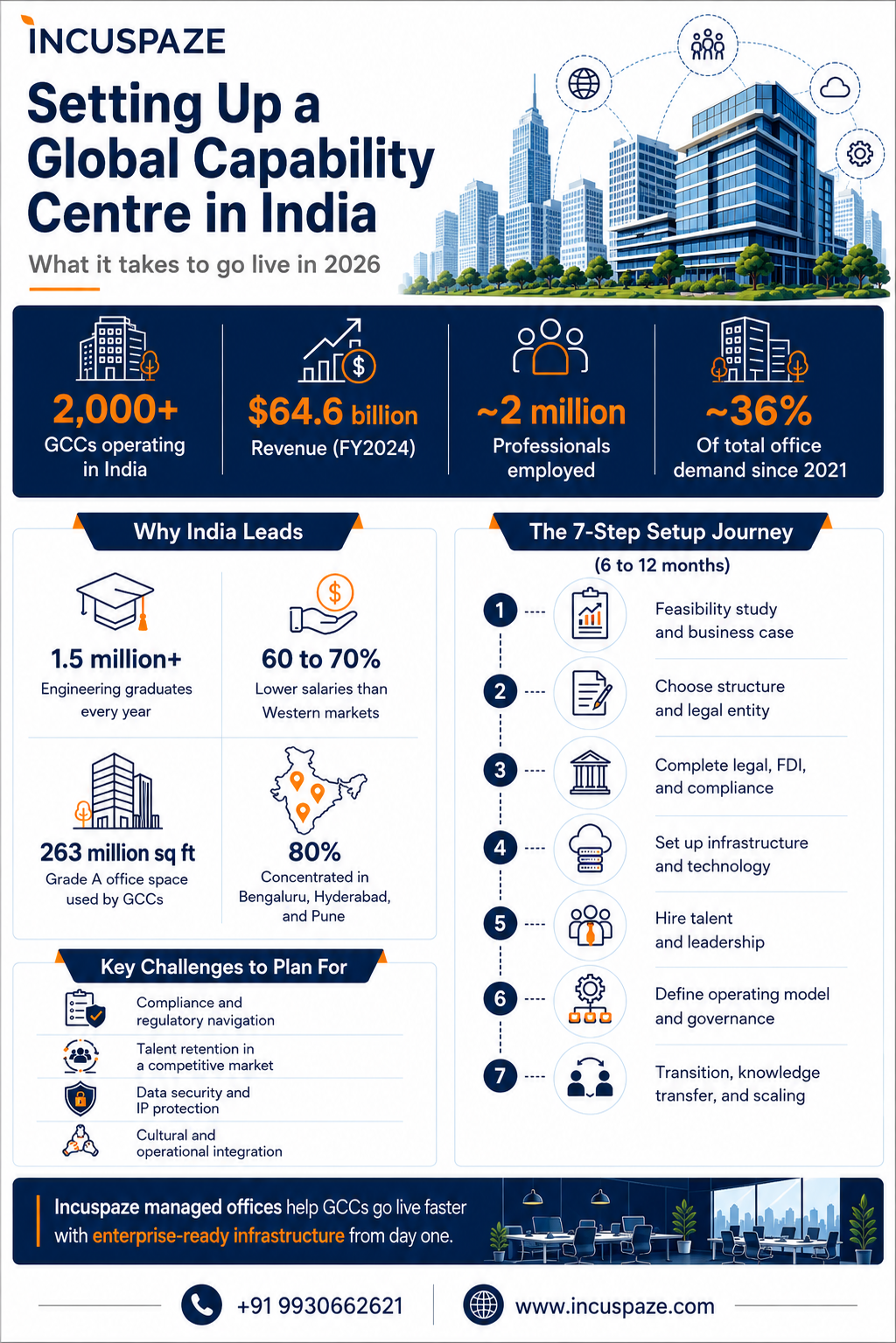
2. Select GCC Structure & Legal Entity
Most multinationals setting up in India opt for a Private Limited Company (wholly owned subsidiary), as it offers full operational control, scalability, and a tax-efficient framework. Branch offices are simpler to set up but carry more restrictions on permissible activities. A Build-Operate-Transfer (BOT) model, where a third-party partner sets up and runs the GCC before transferring ownership, is increasingly used by companies that want to reduce early-stage risk.
3. Complete Legal, FDI & Compliance Requirements
Key compliance areas for GCC setup in India include entity registration under the Companies Act 2013, FDI compliance under FEMA 1999 and RBI guidelines; transfer pricing rules (the Union Budget 2026 set a uniform 15.5% safe harbour margin); and data protection under the DPDP Act 2023 (full compliance required by May 2027). Companies should also explore state-specific incentives such as Karnataka's GCC Policy, which targets 500 new centres by 2029, and Maharashtra's GCC Policy 2025. SEZ registration is optional but provides significant tax benefits, including duty-free imports.
4. Infrastructure & Technology Setup
This step involves securing office space, setting up IT infrastructure, and establishing operational systems. Building out dedicated office infrastructure from scratch typically adds 6–12 months and requires coordination across real estate, IT vendors, and facility managers. Managed office providers eliminate this complexity entirely, enabling companies to move into enterprise-ready spaces from day one.
Incuspaze's managed office spaces are purpose-built for GCC operations, with enterprise-grade IT, security, and facility management already in place.
5. Talent Acquisition & Leadership Setup
Hiring the right talent is critical for GCC success. Companies build leadership teams and recruit skilled professionals aligned with business functions. India's talent pool supports hiring across engineering, analytics, finance, and operations, but structured hiring plans are necessary to ensure continuity.
6. Operating Model & Governance Framework
Organisations define how the GCC will function within the global structure. This includes reporting lines, decision-making processes, performance metrics, and governance policies. A well-defined operating model ensures alignment between headquarters and offshore teams.
7. Transition, Knowledge Transfer & Scaling
During transition, companies should define clear KPIs for the India team, covering outcome metrics such as cost-to-serve, release velocity, and error rates rather than effort-based metrics like hours logged. Starting handovers with lower-criticality functions reduces operational risk during the transition window.
Key Challenges in Setting Up a GCC in India
While India offers strong advantages, companies often face practical challenges during GCC setup. Understanding these early helps in better planning and execution.
Compliance and Regulatory Navigation
India's regulatory environment requires careful navigation across company laws, tax structures, and labour regulations. Delays in approvals or incomplete documentation can slow down the setup process if not managed properly.
Talent Retention and Competition
India offers a strong talent pool, but competition for skilled professionals is high, especially in major cities. Retaining experienced talent requires competitive compensation and meaningful career progression. GCC attrition dropped from 13% in 2023 to 9% in 2025 as professionals began to view these centres as genuine career hubs rather than transitional roles, a shift driven largely by investment in the employee experience and senior leadership exposure.
Data Security and IP Protection
Global companies must ensure that their GCC operations meet strict data security and intellectual property protection standards. This requires a secure IT infrastructure, access controls, and compliance with global security frameworks.

Cultural and Operational Integration
Integrating offshore teams with global headquarters requires alignment in communication, processes, and work culture. The most successful GCCs invest early in cross-border collaboration norms, shared tooling, and leadership exchange programs, treating cultural integration as an operational priority rather than a soft add-on.
Why India Remains the Ideal Destination for Your GCC
India continues to be the preferred destination for GCC setup because it combines talent availability, cost efficiency, and digital readiness at scale. Companies can build advanced capabilities across engineering, analytics, and global operations while maintaining operational control and flexibility. A structured GCC setup roadmap, starting from feasibility analysis to scaling, helps organisations reduce risk and accelerate execution. For most global companies, the single biggest friction point in going live is not legal complexity or talent; it is infrastructure and workspace readiness.
For companies looking to simplify infrastructure and operational complexity, Incuspaze offer premium managed office spaces designed to support GCC operations. With flexible workspace solutions, enterprise infrastructure, and end-to-end facility management, businesses can focus on building capabilities while the workspace environment is managed efficiently.