



Introduction
India overtook Japan to become the world's fourth-largest economy in 2025, with a nominal GDP of $4.187 trillion. That shift didn't happen in isolation. That economic shift is reshaping how Indian enterprises operate from the inside out.
India isn't just tracking the global future of work trends. It's generating them. GCC expansion, a young workforce entering the market at scale, accelerating AI adoption, and a hard pivot toward experience-first workplaces are all happening simultaneously. This blog covers what's driving India's workplace transformation in 2026, which trends are structural, and what C-suite leaders need to act on now.
What Is the Future of Work in India
The future of work is how work, workers, and workplaces are evolving in response to technology, demographics, and shifting employee expectations. In India, this shift is already underway across enterprises, shaped by AI adoption, hybrid models, GCC expansion, and skills-based hiring.
Three dimensions matter most for India:
- Where work happens – the rise of hybrid and distributed models replacing fixed, single-location offices
- How work happens – AI-assisted workflows, automation, and skills-based team design replacing rigid role definitions
- Why work happens – purpose-driven roles, employee well-being, and talent retention replacing pure productivity metrics
Future of Work Trends Reshaping Indian Workplaces in 2026
Five trends are reshaping how Indian businesses think about work, talent, and workspace in 2026. GCC growth, AI integration, and a fundamentally different talent market are all landing at the same time, and the businesses adapting fastest are the ones already rethinking their assumptions.
AI Is Shifting from Tool to Workplace Partner
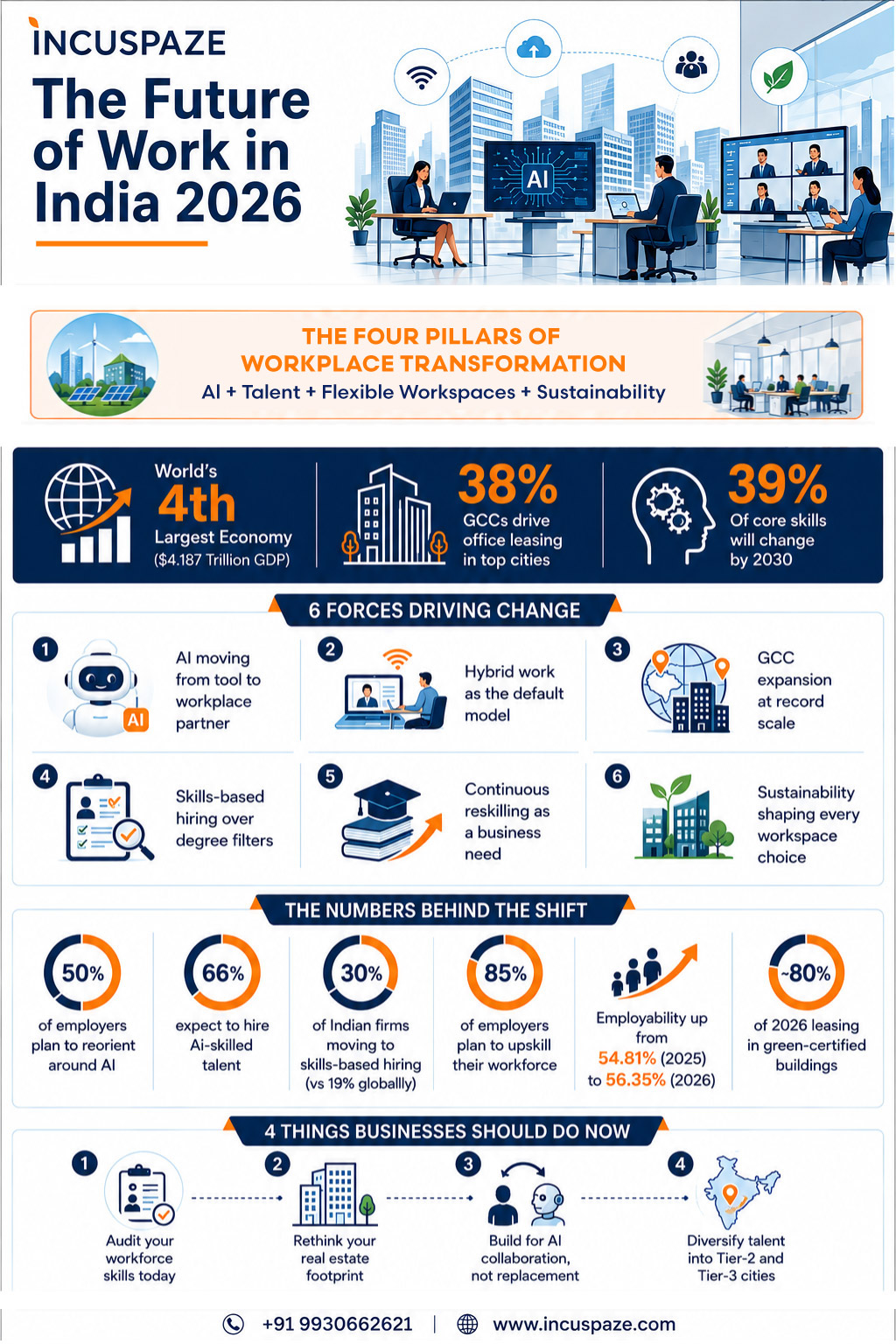
Generative AI has moved well past being a productivity experiment. It's now embedded in daily workflows across finance, legal, engineering, and customer operations. According to the World Economic Forum's Future of Jobs Report 2025 , 50% of employers plan to reorient their businesses in response to AI, while 66% expect to hire talent with AI-specific skills.
But here's what most leaders get wrong: AI isn't replacing entire roles in most sectors. It's changing what roles contain. The demand for creative thinking, adaptability, and emotional intelligence is rising alongside technical fluency, not instead of it. Companies building for AI collaboration rather than AI replacement are getting ahead.
Hybrid Work Is Now the Default, Not the Exception
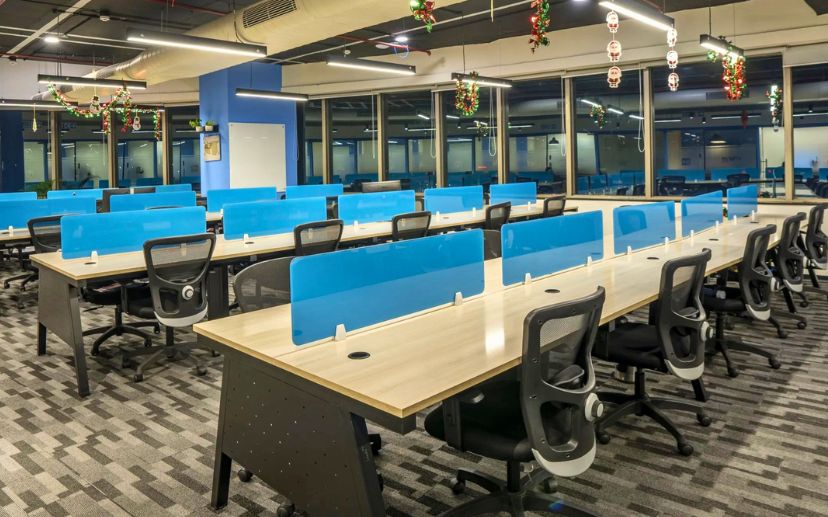
Hybrid work stopped being a post-pandemic experiment three years ago. It's now simply how most knowledge workers in India operate, and office strategy has had to follow. Rather than fixed, centralised headquarters, companies are moving toward distributed workspace ecosystems, mixing managed offices , flex centres, and GCC campuses across cities.
According to JLL's India GCC Guide 2026 , GCCs contributed 38% of office leasing across India's top seven cities in 2025, the highest volume ever recorded, and much of that demand is being shaped by hybrid workforce planning that needs agile, scalable office formats. The question for businesses today isn't whether hybrid works. It's how to design a workspace around it without over-committing capital.
Skills-Based Hiring Is Replacing Credential-Led Recruitment
Degrees are losing their grip as the primary hiring filter, and India is leading that shift. Around 30% of companies in India plan to move towards skills-based hiring by removing degree requirements, compared to just 19% globally.
The reason is straightforward. India's overall employability rate has increased from 54.81% in 2025 to 56.35% in 2026, continuing a steady upward trend from 46.2% in 2022, reflecting India's transition towards a digital, skill-driven economy. With roughly 15 million new graduates entering the market each year, employers can't rely on credentials alone as a quality signal. Skills taxonomies, apprenticeships, and internal talent marketplaces are replacing traditional job descriptions, especially in the BFSI, tech, and manufacturing sectors across the GCC.
Reskilling and Continuous Learning Are Now Business Imperatives
The case for reskilling is straightforward. Companies that delay are watching their skill gaps widen, and recruitment costs rise. 85% of employers plan to upskill their workforce in response to growing skills gaps, with half of businesses planning to transition staff into growing roles.
What does reskilling actually look like in practice? Short online courses, internal skill-sharing programs, and structured learning time are built into the work week. It doesn't have to be a large formal program. The businesses getting this right are treating learning as an operational function, not an HR initiative.
Sustainability and ESG Are Shaping Workplace Design
Green buildings and energy-efficient workspace design have moved from aspiration to procurement criteria, particularly for GCCs and multinationals entering India. Two-thirds of India's Grade A office stock is already green-certified, and roughly 80% of leasing in 2026 is projected to happen in green-certified, tech-integrated buildings.
Sustainability and workspace agility are now co-criteria in enterprise real estate decisions. For organisations with global net-zero commitments, non-certified buildings aren't just less preferred. They're increasingly ruled out entirely.
The Future of Remote Work: Is the Office Making a Comeback?
No, the office isn't replacing remote work, and remote work isn't replacing the office. Both remain relevant in 2026. What's changed is what the office is for.
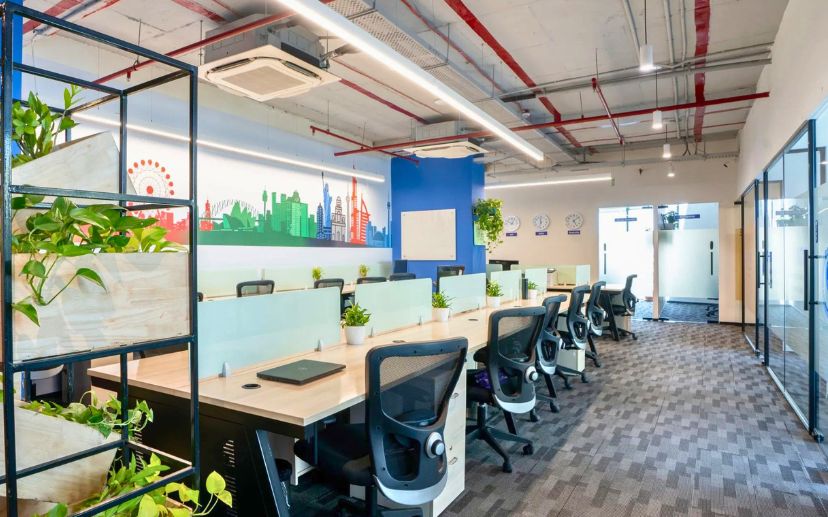
Employees expect flexibility. Most knowledge workers aren't coming in five days a week, and companies that require that are losing talent to those that don't. At the same time, offices across India are being redesigned for what remote work can't do well: complex collaboration, onboarding, culture-building, and client engagement.
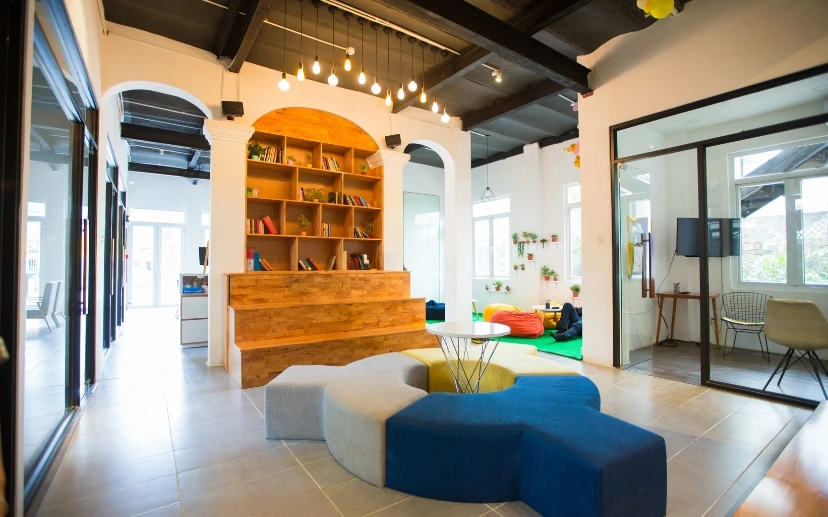
Today's standard fit-out brief for any new enterprise office includes:
- More meeting rooms
- Better AV infrastructure
- Lounge and breakout spaces
- Hybrid-ready collaboration tech
The growth in managed and flex office demand reflects this directly. Businesses want right-sized, adaptable offices, not large fixed commitments that lock them into space they may not need in two years. That's the demand driving growth in managed office spaces across India.

What Should Indian Businesses Do Now
Four things worth acting on, not just planning:
Audit your workforce skills today
Not at the next review cycle. With 39% of core job skills projected to change by 2030, these shifts demand urgent action from employers. Waiting is not a neutral position.
Rethink your real estate footprint
Long-term leases in fixed offices are increasingly misaligned with how teams actually work. Evaluate managed office and flex workspace options that let you scale without committing capital prematurely.
Build for AI collaboration, not AI replacement
Review which workflows can be augmented by AI today, and identify the human skills you need to develop alongside that adoption.
Diversify your talent sourcing geography
Tier-2 and Tier-3 cities such as Lucknow, Kochi, and Chandigarh are emerging as strong employability hubs. GCCs that have moved into Hyderabad, Pune, and Ahmedabad are finding comparable talent at a different cost structure.
Why Incuspaze Helps Businesses Navigate the Future of Work in India
The future of work in India comes down to a few realities: hybrid work is permanent, AI adoption is accelerating, talent is distributed across cities, and workspace decisions need to be faster and more flexible than they used to be.
Businesses must act now by reskilling teams, rethinking office strategy, and designing workplaces built for collaboration rather than just occupancy. India's young workforce, growing GCC ecosystem, and expanding Tier-2 talent hubs make the opportunity significant, but only for organisations that move with it.
Incuspaze's managed offices and coworking spaces let businesses set up, scale, and pivot across 80+ locations in 18+ cities without long-term lease commitments or upfront capital. Whether you're setting up a GCC, scaling a hybrid team, or entering a new market, Incuspaze provides the infrastructure so your leadership team can focus on growth, not fit-outs.