



Key Trends Shaping the Future of Office Spaces
Five trends are reshaping how enterprises plan, lease, and operate office space, each with direct implications for cost, risk, and talent strategy.
Hybrid and Flexible Work Models
Hybrid work has moved from a pandemic-era exception to a standard operating model for enterprises across sectors. Businesses are reassessing fixed headcount assumptions and moving towards a mix of owned space and flexible capacity that can expand or contract with demand. CBRE's Q2 2026 figures put numbers behind this: flexible space operators were the largest occupier group of the quarter, leading leasing activity with a 27 percent share, ahead of technology companies at 21 percent and BFSI at 13 percent.
This shift changes the underlying real estate question from "how much space do we lease" to "how much flexibility do we need to occupy or exit quickly." For CFOs and heads of real estate, this translates directly into lower capex exposure and shorter decision cycles when entering new markets.
Smart and Technology-Enabled Offices
Modern offices increasingly run on integrated technology, including IoT-enabled access control, occupancy sensors, energy management systems, and AI-driven space analytics. According to CBRE's India Office Market Outlook 2026, AI integration is driving demand for premium office spaces equipped with high-performance digital infrastructure, secure data zones, and adaptable layouts designed for specialised talent.
For enterprises and GCCs handling sensitive data, this technology layer is now a baseline site-selection requirement, not an add-on.
Employee-Centric and Wellness-Focused Design
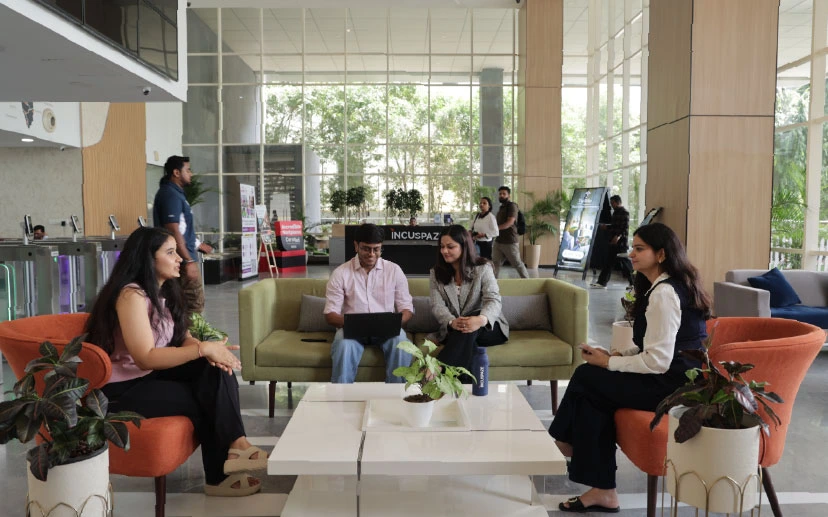
Office design is shifting from a purely functional layout to one built around employee experience, incorporating breakout zones, wellness rooms, ergonomic furniture, and biophilic elements. Employees return to the office when it offers something remote work cannot, namely collaboration, mentorship, and a better working environment.
For enterprises competing for skilled talent, workplace design has become a measurable factor in retention.
Sustainability and Green Office Buildings
Sustainability has moved from a compliance checkbox to a core leasing criterion, with occupiers increasingly prioritising green-certified buildings, energy-efficient systems, and measurable ESG outcomes. Enterprise tenants, particularly MNCs and GCCs reporting against global ESG frameworks, now factor a building's sustainability credentials into site selection alongside cost and location.
Providers demonstrating certified, energy-efficient infrastructure are increasingly favoured in enterprise RFPs.
Smaller, High-Quality, Purpose-Driven Offices
Rather than leasing the largest possible footprint, enterprises are increasingly choosing smaller, high-quality spaces designed around specific functions, such as collaboration hubs, client-facing floors, or specialised R&D zones. Leasing activity is balanced between mature enterprises expanding their footprint through large deals and mid-sized or new entrants opting for smaller, targeted spaces.
This purpose-driven approach lets organisations align real estate spend more closely with actual utilisation.
The Future of Office Spaces in India
India has become a critical market for modern office spaces, driven by sustained multinational and GCC expansion and a large, skilled workforce that supports complex, high-value operations. Major cities such as Bengaluru, Hyderabad, Delhi NCR, Mumbai, and Pune are adapting quickly to these changes. Flexible leasing volumes are rising, and demand for Grade A stock continues even as overall market conditions shift. CBRE expects India's total office stock to pass 1 billion sq ft during 2026.
Each of those cities is pulling a different mix of occupiers, which is why space requirements look so different from one market to the next.
| City | Top 3 Industries Driving GCC Demand | What Anchors the City |
|---|---|---|
| Bengaluru | Technology, Engineering & Manufacturing, BFSI | Largest GCC base in the country; roughly four in ten Indian GCCs sit here, concentrated along ORR, Whitefield and North Bengaluru |
| Hyderabad | Life Sciences, BFSI, Engineering & Manufacturing | Has moved from cost-led delivery to product, R&D and engineering mandates; demand is almost entirely in the IT Corridor |
| Pune | BFSI, Engineering & Manufacturing, Technology | Preferred base for product development and ER&D; Kharadi and the CBD absorb most of the leasing |
| Chennai | BFSI, Engineering & Manufacturing, Life Sciences | Semiconductor, electronics and hardware-led engineering work; OMR and PT Road dominate |
| Mumbai | BFSI, Research/Consulting & Analytics, Technology | India's deepest BFSI ecosystem, driving engineering and fintech GCCs; Western Suburbs and Navi Mumbai lead |
| Delhi NCR (Gurugram, Noida, Delhi) | Technology, Research/Consulting & Analytics, BFSI | Consulting, analytics and regulatory operations; demand clusters on NH-8 and the Noida Expressway |
India's office market recorded its strongest ever quarterly performance in Q2 2026, with gross leasing reaching approximately 24.6 million sq ft. This represented an increase of 18 percent quarter on quarter and 14 percent year on year, while GCCs accounted for 42 percent of total office space taken up during the period. CBRE further forecasts that GCCs will drive over 40 per cent of total space absorption across India through 2026.
Two factors run underneath all of this: employees are back in offices at scale, and companies are choosing smaller, high-quality, tech-enabled workspaces over large generic floorplates.
How the Future Office Impacts Businesses and Employees
Modern, well-designed office space is no longer a cost centre; it directly influences productivity, collaboration, talent attraction, and cost efficiency. Technology-enabled flexible offices remove the administrative drag that sits behind daily operations. Teams get quick access to meeting rooms, stronger connectivity, and spaces designed for both focused tasks and group collaboration.
For employees, a well-designed office supports work-life balance by making in-office time genuinely worthwhile rather than a default requirement. This shapes how companies keep and attract people, especially those competing for rare specialist talent in cities like Bengaluru and Hyderabad.
For businesses, the cost efficiency case is equally direct. Flexible and managed office models help companies avoid high upfront costs. They make moving in faster and allow organisations to increase or reduce seats based on actual team size, instead of locking into a fixed space years ahead.
If your current lease is up for review, Incuspaze's enterprise workspace team can model the cost and flexibility trade-offs against your existing footprint before you commit to anything.

What Will the Office Look Like in the Next 5-10 Years
The office of the next five to ten years will not settle into a single fixed format. It will continue iterating in response to shifting workforce needs, technology, and business priorities. Companies will regularly review how much space they need as hybrid work and team sizes shift.
Resilience and scalability will define successful office strategies over this period. Enterprises and GCCs will increasingly favour operating models that let them adjust footprint quickly. They want to expand into new cities, consolidate fragmented offices, or reallocate space between collaborative and focused work without the multi-year lock-in of a conventional lease.
Why India Remains the Ideal Destination for Your GCC
India remains the leading destination for GCC setup, supported by deep talent availability across engineering, analytics, and technology functions. This strength is further reinforced by sustained cost efficiency compared to other hubs and digital infrastructure that enables complex, high-value operations.
State policy is now a fourth pillar alongside talent, cost, and infrastructure. Almost every major state has published a GCC policy of its own, and each is competing on a different pitch, which increasingly shapes where a new centre lands.
| State (Policy) | Stated Target | How the State Is Positioning Itself | What the Policy Actually Offers |
|---|---|---|---|
| Karnataka (GCC Policy 2024-2029) | Around 1,000 centres by 2029 | Innovation-first ecosystem, expanding well beyond Bengaluru | Capital subsidy, talent grants, rent support, infrastructure funding, property tax waivers |
| Telangana (TS-iPASS, IT/ITeS, T-Hub, TASK) | GCC growth spread across multiple cities, not just Hyderabad | Deep talent base built for digital and R&D-heavy mandates | Single-window fast-track clearances, innovation ecosystem funding, skilling programmes |
| Maharashtra (GCC Policy 2025-2030) | 400+ new centres by 2030 | Twin-engine model, with BFSI out of Mumbai and ER&D out of Pune | Capex and rental subsidies, payroll support, power tariff relief, R&D grants |
| Haryana (GCC Policy 2026-2031) | Volume tied to NCR spillover demand | A lower-cost extension of NCR, backed by a dedicated policy push | Capex and opex incentives, R&D funding, EPF reimbursement |
| Uttar Pradesh (GCC Policy 2025-2030) | Volume-led GCC expansion statewide | Scale and cost advantage on the back of a very large workforce | Capex support, opex reimbursement, payroll incentives, EPF reimbursement, land and interest subsidy |
| Tamil Nadu (GCC Incentive 2024-2027) | High-value ER&D mandates | Engineering and manufacturing depth for product development work | Payroll support, land subsidy, operational duty exemptions |
| Gujarat (GCC Policy 2025-2030) | 250+ additional centres by 2030 | Finance-meets-industry hub anchored by GIFT City | Capex and opex subsidies, EPF reimbursement, interest subsidy, certification support |
| Kerala (GCC Policy 2025-2030, draft) | Tripling its base to 120 centres by 2030 | Talent-led model with unusually low attrition and distributed growth | Capex support, land conversion and lease subsidies, property tax relief, stamp duty waiver, R&D grants |
| Rajasthan (GCC Policy 2025-2030) | Over 200 centres by 2030 | Cost-competitive market leaning on NCR proximity | Capex subsidy, payroll incentives, land and lease support, interest subsidy, green building incentives |
| Madhya Pradesh (GCC Policy 2025-2029) | 50-plus centres by 2029 | Early-stage destination built around scalable, low-cost operations | Capex subsidy, payroll incentives, interest subsidy, R&D assistance, training and rental support |
| Andhra Pradesh (IT & GCC Policy 2024-2027) | Positioning as a deep-tech growth hub | Infrastructure-first ecosystem centred on Visakhapatnam | Capex subsidy, power tariff support, job-creation incentives, rental assistance |
CBRE's India Office Market Outlook 2026 expects GCCs to keep pivoting towards high-complexity R&D and global product ownership roles, so organisations expanding here are scaling advanced capability rather than routine support functions. Companies planning a GCC setup benefit from following a structured roadmap that includes feasibility analysis, location and talent mapping, real estate strategy, and a phased scale-up plan.
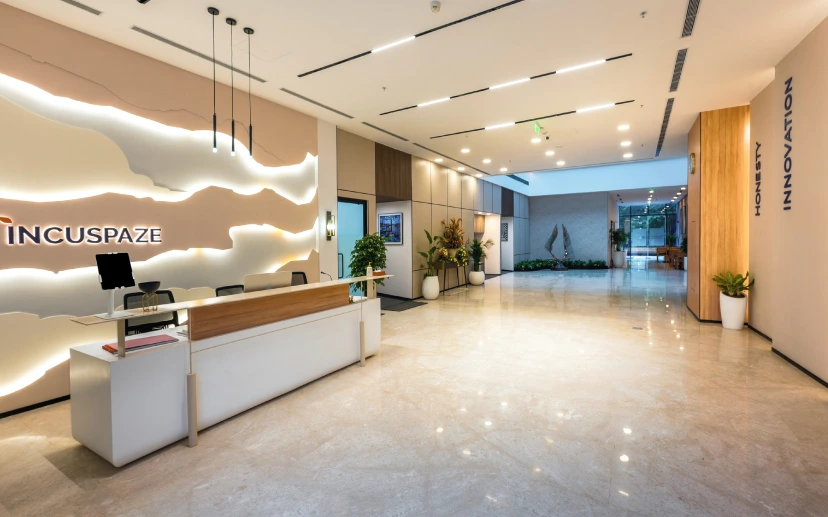
Incuspaze offers premium managed office spaces across 15 Indian cities, configured for enterprise and GCC requirements. With a pan-India presence and zero capex, CXOs get a faster, lower-risk route to scale than a conventional lease allows. Book a site visit to see how the model works against your current footprint.
How Businesses Can Prepare for the Future of the Office
Enterprises that plan deliberately for these shifts will be better positioned to control cost and risk as workplace models continue to change.
Reassessing Office Space Requirements
Businesses should regularly audit actual space utilisation against current headcount and hybrid work patterns, rather than relying on assumptions set years earlier. This reassessment should factor in projected growth, GCC expansion plans, and the split between collaborative and focused work areas.
Investing in Smart Infrastructure and Technology
Technology infrastructure, from occupancy sensors to secure digital access, should be treated as a core leasing requirement rather than a retrofit. Enterprises evaluating new space should confirm a building or provider's technology readiness before signing, particularly for data-sensitive GCC operations.
Prioritising Employee Experience and Flexibility
Workplace strategy should account for what actually draws employees into the office, such as wellness amenities, ergonomic design, and genuine flexibility in how space is used. This is increasingly a retention lever, not just a design preference.
Choosing Sustainable and Scalable Office Solutions
Enterprises should prioritise providers and buildings with verifiable sustainability credentials and the ability to scale seats or floors within the same relationship. This reduces both ESG reporting risk and the operational disruption of switching providers as requirements change.
Key Takeaways
India's office market is being shaped by global capability centres more than any other group. GCCs now account for well over 40% of the space being leased, and they are not all looking for the same thing. Mumbai draws financial services, Hyderabad pulls life sciences, Chennai attracts engineering work. Most states have also introduced their own GCC policies, so incentives now sit alongside talent and cost when companies decide where to set up.
What has changed most is what companies want from an office. Fewer are taking large, generic floors on long leases. The preference has moved towards smaller, better-quality, well-connected space that can grow or shrink as teams do.
Incuspaze's managed office spaces are built for exactly this, giving enterprises and GCCs ready-to-use offices across 15 Indian cities without the upfront cost or lock-in of a traditional lease.